
Preferences
Privacy is important to us, so you have the option of disabling certain types of storage that may not be necessary for the basic functioning of the website. Blocking categories may impact your experience on the website. More information

Privacy is important to us, so you have the option of disabling certain types of storage that may not be necessary for the basic functioning of the website. Blocking categories may impact your experience on the website. More information
Bring your Google Search Console into Claude, ChatGPT, Cursor and any MCP client. Free SEO + AI-visibility (GEO) diagnosis, straight in your chat.














Sorank exposes a remote MCP server so your AI assistant can read your Google
Search Console data in plain language: quick wins, performance trends, indexing
status, sitemaps, long-term history kept past Google's 16-month limit, and the
biggest movers.
It is read-only and uses your own Google account. Sorank never changes
your site or your Google account.
MCP server URL
https://mcp.sorank.com/functions/v1/mcp
Every client below uses the same flow. You paste the URL once; the client opens
your browser to sign in with Google and grant read-only Search Console
access. There is nothing else to configure: no API key, no client ID, no
token. The server handles registration and authorization automatically (OAuth
2.1 with dynamic client registration).
Example prompts:
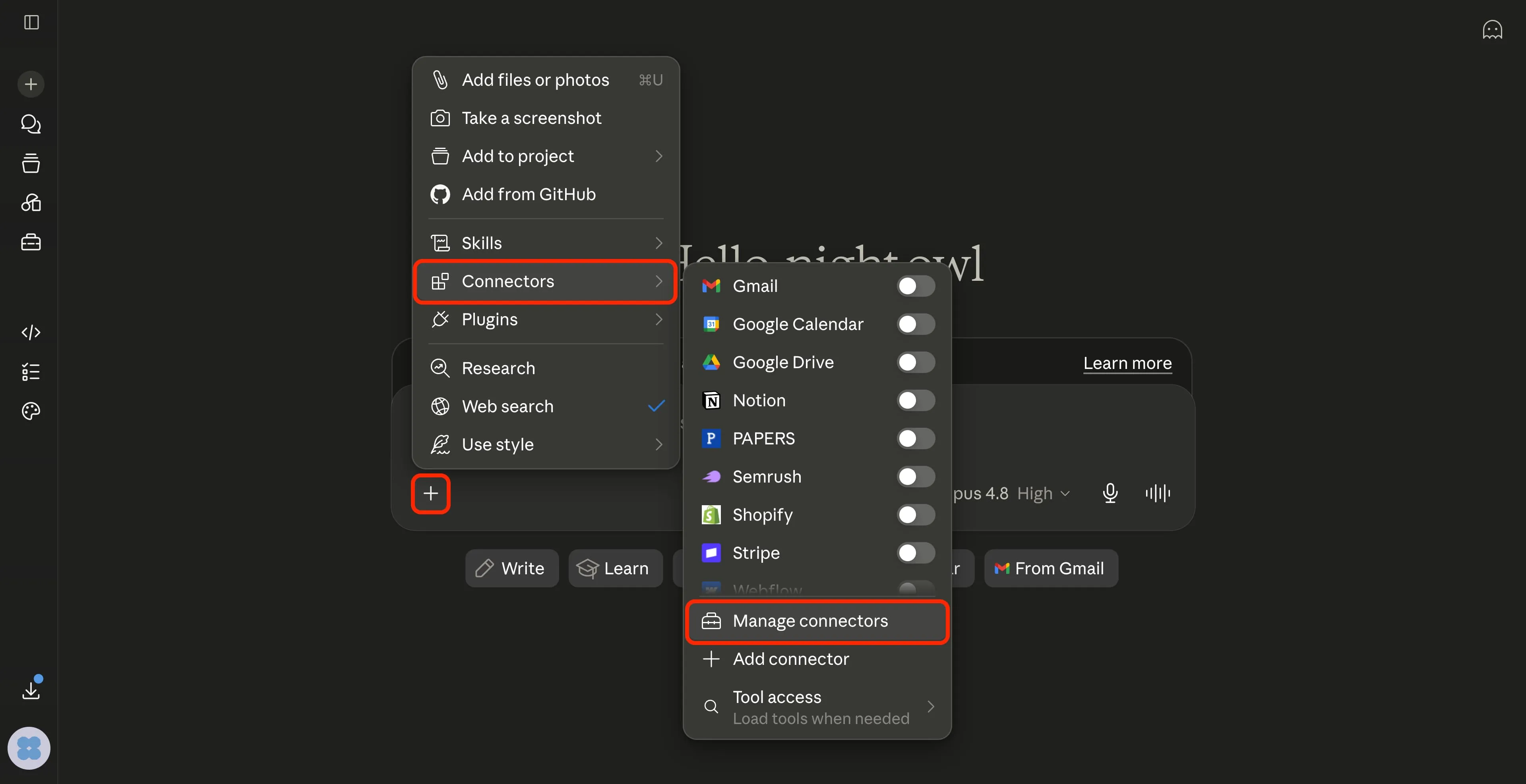
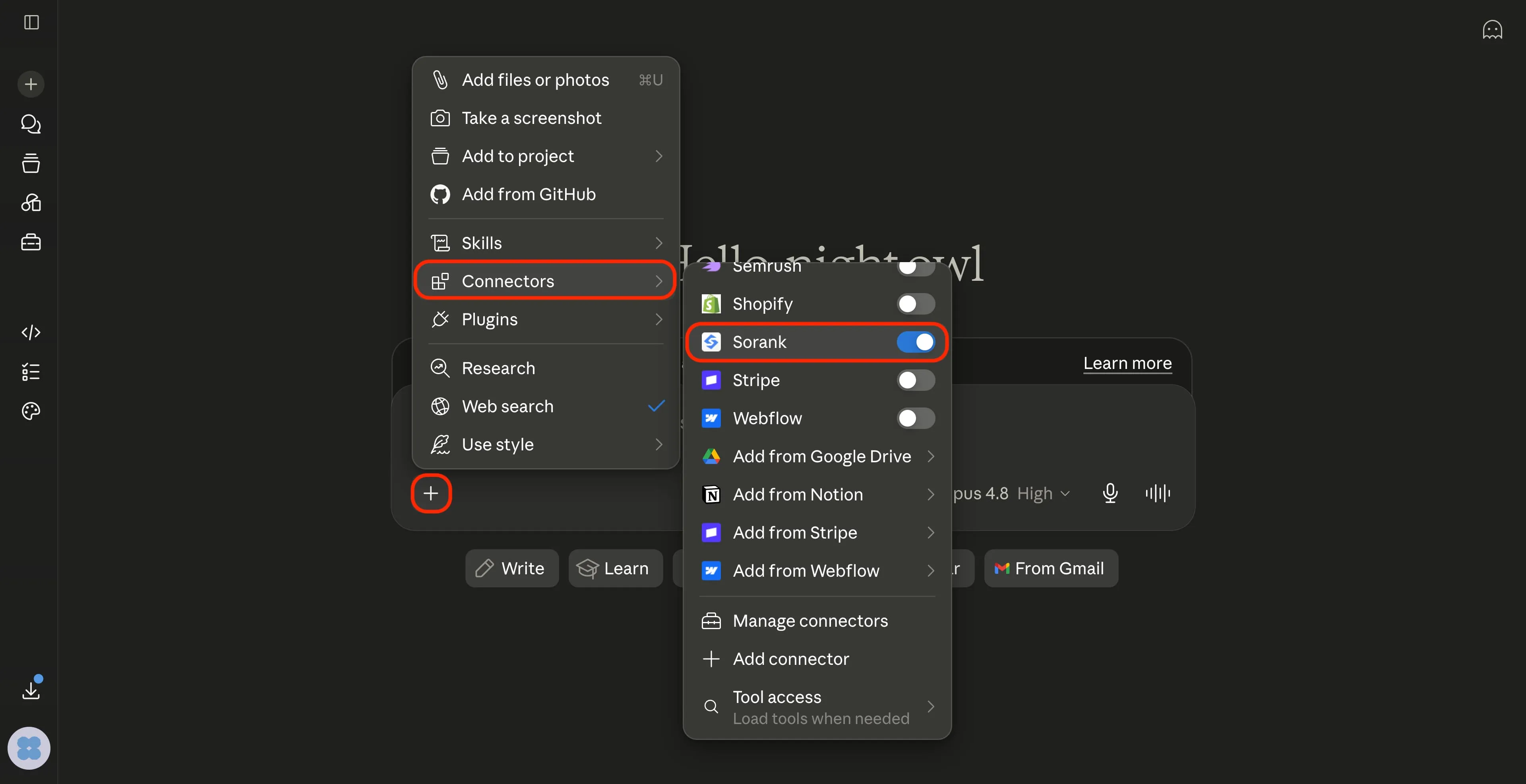
On the Claude home screen, click the + button at the bottom-left of the message box. In the menu, hover Connectors, then click Manage connectors at the bottom.
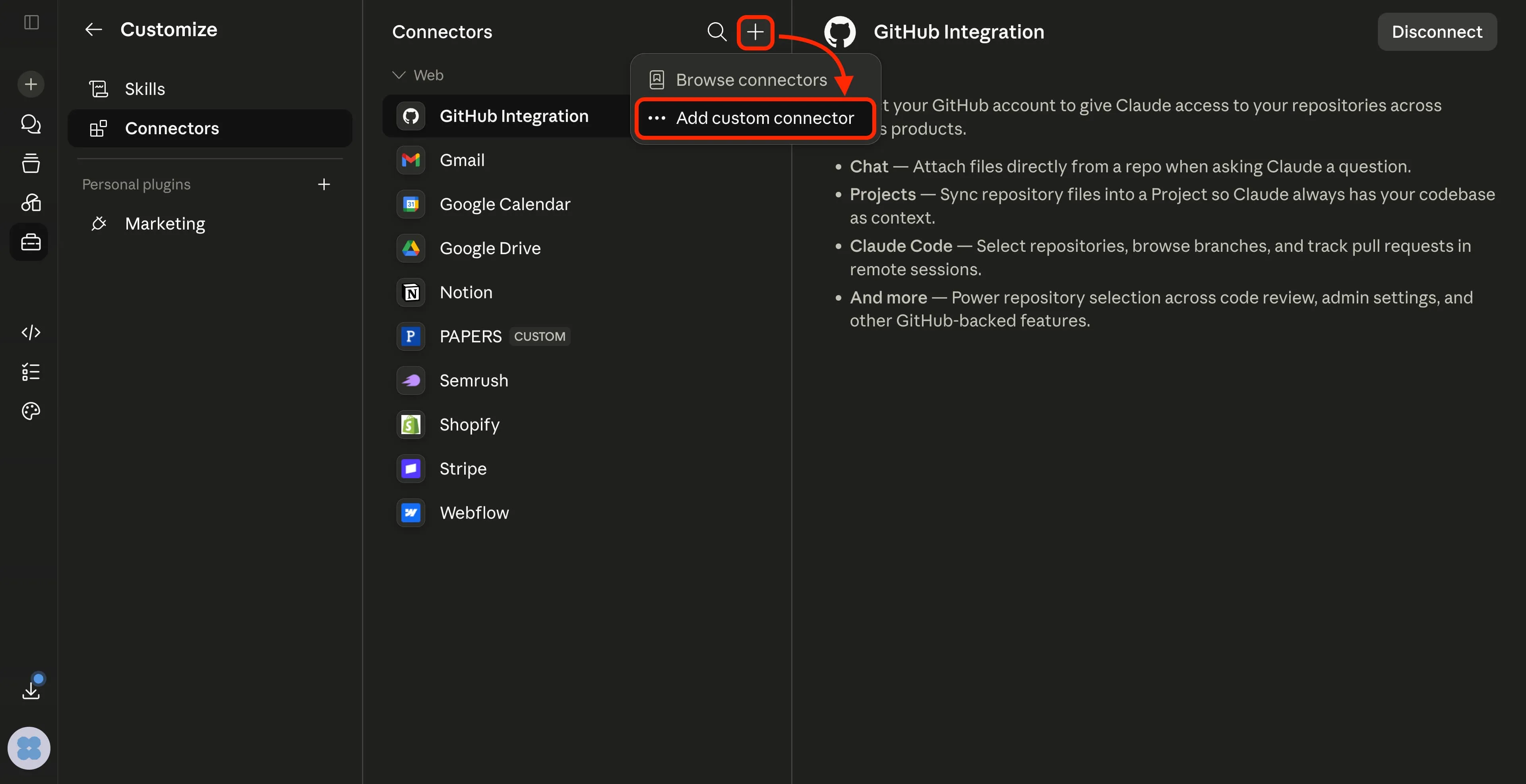
You're now in Customize → Connectors. Click the + at the top-right of the Connectors list, then choose Add custom connector.
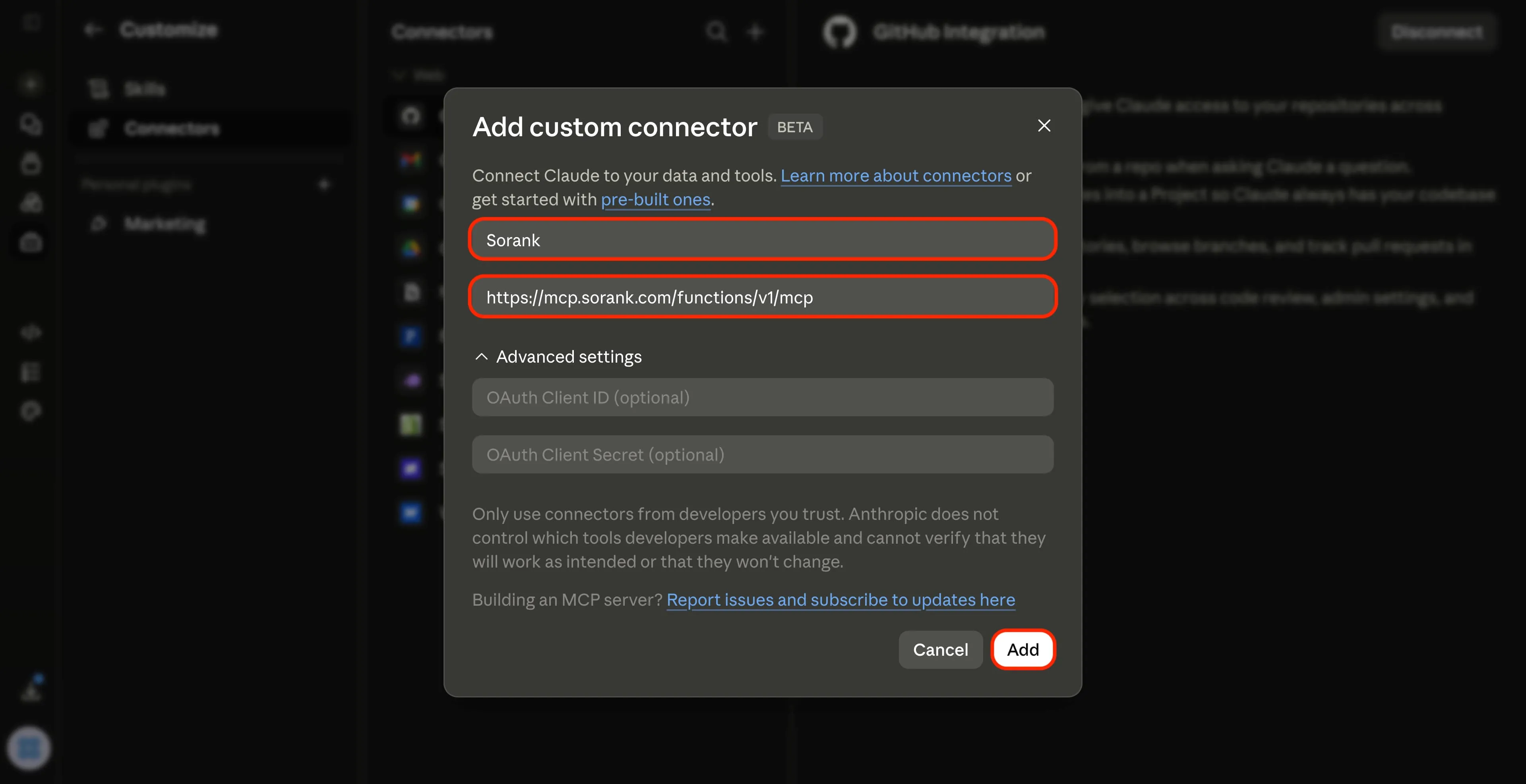
In the dialog, fill in :
Name : Sorank
URL : https://mcp.sorank.com/functions/v1/mcp
Leave AOAuth Client ID / Secret empty.
Click Add.
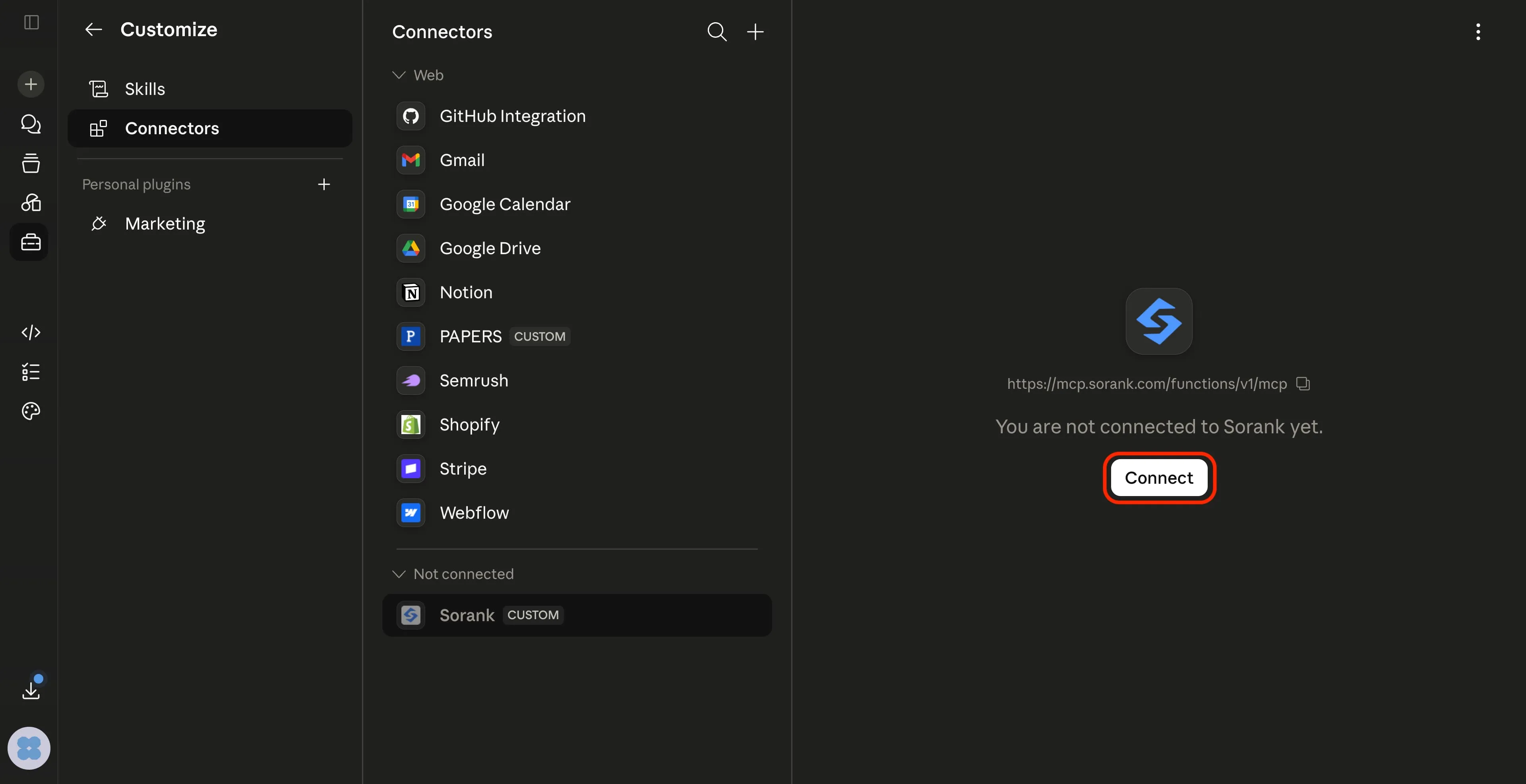
Sorank now appears under Not connected.
Select it and click Connect.
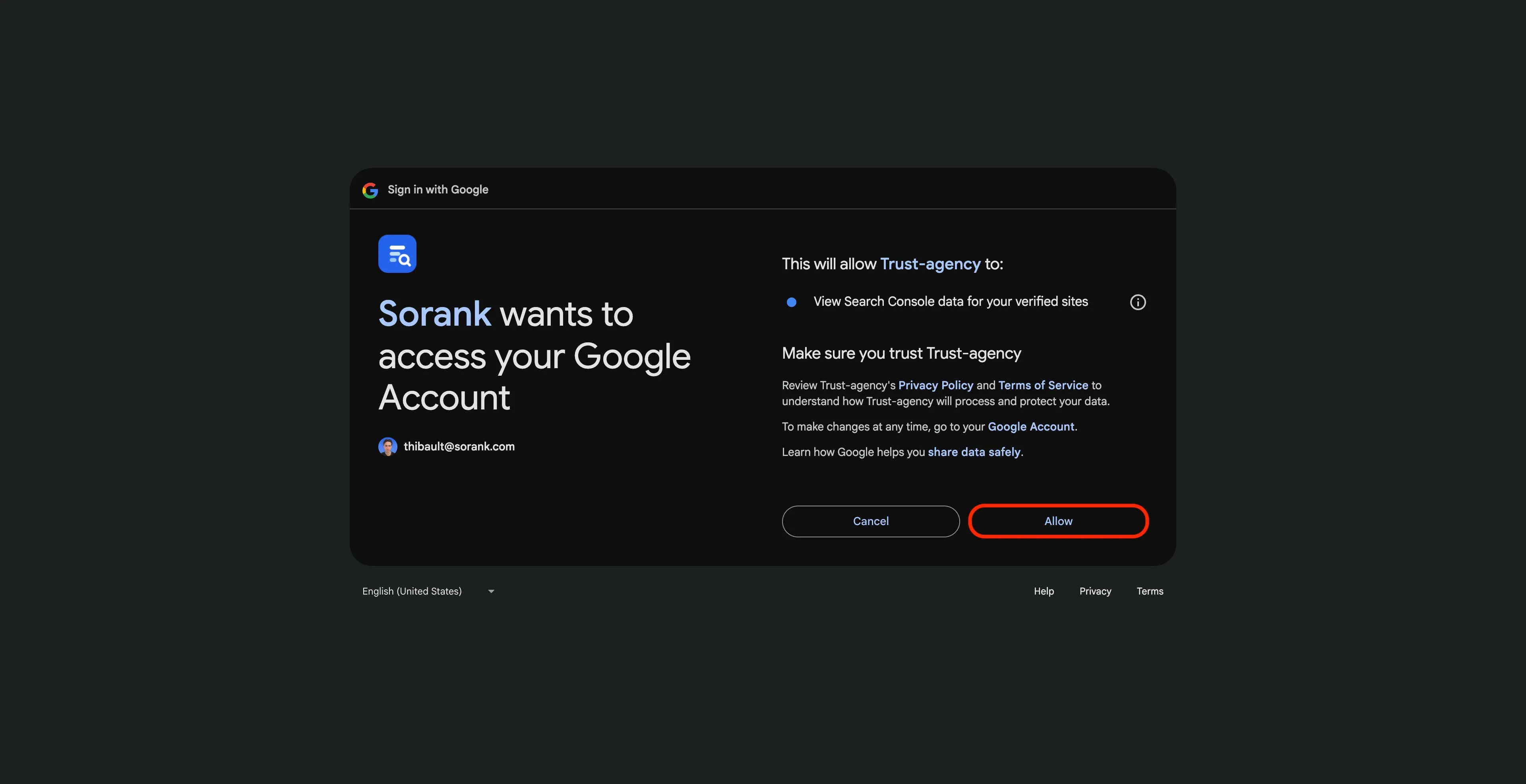
A Google window opens. Pick your account and approve read-only access to your Search Console.
(Read-only, Sorank never modifies your Search Console.)
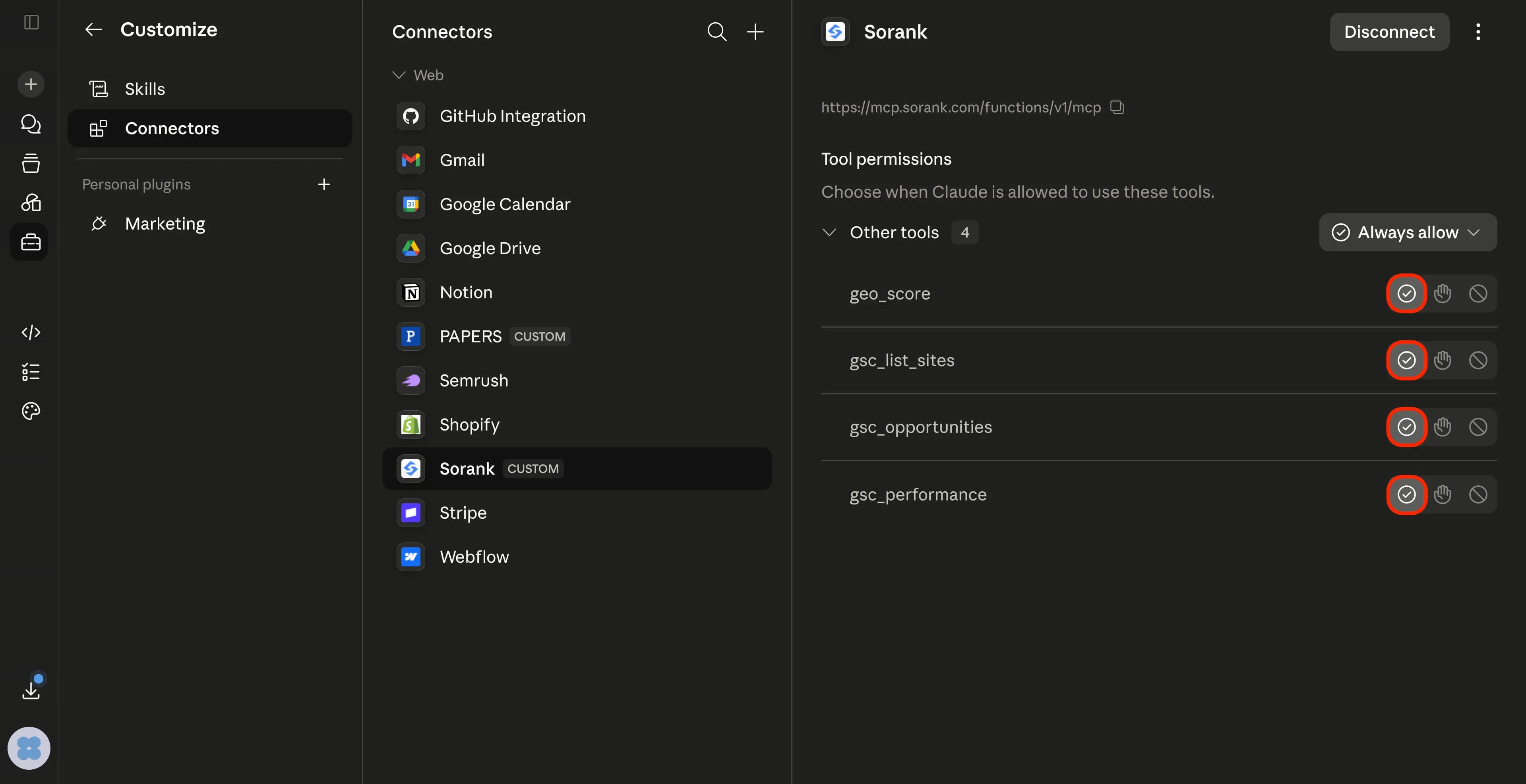
Sorank is now connected.
On its page you'll see Tool permissions with four tools: gsc_list_sites, gsc_performance, gsc_opportunities and geo_score.
Leave them on Always allow so Claude can run them without asking every time.
In any chat, click + → Connectors and make sure the Sorank toggle is on. Then ask, for example:
"With Sorank, list my Search Console sites, then show my top quick-win keywords."
You'll get your live Search Console insights right in the conversation.
Requires VS Code 1.102 or newer, GitHub Copilot signed in, and Agent
mode in Copilot Chat.
One click:
Ctrl/Cmd + Shift + P) -> MCP: Add Server.Or with a file - create .vscode/mcp.json (per project) or add the sameservers block to your user settings.json under mcp:
{
  "servers": {
    "sorank": {
      "type": "http",
      "url": "https://kcgtdxrygpvazuecnggt.supabase.co/functions/v1/mcp"
    }
  }
}
Click Start above the entry, then complete the Google sign-in.
Use it in Copilot Chat -> Agent mode (make sure Sorank is enabled in the
tools picker).
~/.cursor/mcp.json.cursor/mcp.json for one project):{
"mcpServers": {
"sorank": {
"url": "https://kcgtdxrygpvazuecnggt.supabase.co/functions/v1/mcp"
}
}
}
~/.codeium/windsurf/mcp_config.json:{
"mcpServers": {
"sorank": {
"serverUrl": "https://kcgtdxrygpvazuecnggt.supabase.co/functions/v1/mcp"
}
}
}
geo_score
Returns a rough GEO (generative-engine / AI search) citability score from 0 to 100 for a given URL, based on signals AI engines favour (structured data, Q&A blocks, concrete stats, clear headings, freshness). It is a light server-side approximation; the full GEO engine lives in the Sorank extension.
Input: url (required)
gsc_list_sites
Lists the Search Console properties the connected Google account can access (verified properties only). This is the starting point, since most other tools need a site_url from here.
Input: none
gsc_sitemaps
Lists the sitemaps submitted for a property and their health: last submitted / downloaded dates, error and warning counts, and submitted-vs-indexed URL counts.
Input: site_url (required)
gsc_inspect_url
Inspects one URL's Google index status (URL Inspection API): indexed or not, last crawl time, coverage state, the canonical Google chose, robots/fetch state, mobile usability and rich-result types. Ideal for diagnosing why a page is (or is not) in Google.
Input: site_url, url (both required)
gsc_performance
Returns Search Console performance for a property: clicks, impressions, CTR and average position, broken down by chosen dimensions (query, page, country, device, date, searchAppearance) over a date range. With compare=true, it also returns the previous equal-length period plus deltas.
Input: site_url (required); optional days, start_date, end_date, dimensions, row_limit, compare
gsc_opportunities
Surfaces quick-win SEO opportunities: queries ranking just off the top (positions 4-20) with real impressions, ranked by the clicks they could gain by reaching the top of page 1. (Free diagnosis; fixes and content are Sorank's paid layer.)
Input: site_url (required); optional days, limit
gsc_movers
Returns the biggest movers from Sorank's long-term store: the queries (or pages) whose clicks rose or fell the most between a recent month and an earlier one, including comparisons further back than Google's 16-month limit.
Input: site_url (required); optional dimension (query/page), months_back, limit
ga_list_properties
Lists the GA4 properties the connected Google account can access. This is the starting point for Analytics, since every other GA tool needs a property_id from here.
Input: none
ga_performance
Returns GA4 traffic performance for a property: users, new users, sessions, engaged sessions, engagement rate, average engagement time and views, broken down by chosen dimensions (date, page, channel, country, device) over a date range. With compare=true, it also returns the previous equal-length period plus deltas.
Input: property_id (required); optional days, start_date, end_date, dimensions, metrics, compare
ga_traffic_sources
Breaks down traffic by acquisition channel, source and medium (organic search, direct, referral, paid, social, email and AI assistants), so you can see where users actually come from and how each source performs.
Input: property_id (required); optional days, limit
ga_conversions
Reports key events and conversions (goal completions, sign-ups, purchases and revenue) by channel and landing page, so you can tie SEO/GEO traffic to real outcomes rather than vanity sessions.
Input: property_id (required); optional days, event_name
ga_audience
Audience and behaviour overview: new vs returning users, devices, countries / languages, and top landing and exit pages with engagement and bounce. A quick read on who your visitors are and how they behave.
Input: property_id (required); optional days
psi_analyze_url
Runs a Google PageSpeed Insights analysis for a single URL: the overall Lighthouse performance score plus the key audits (LCP, Total Blocking Time, CLS, Speed Index) and the top opportunities to make the page faster, for mobile and/or desktop.
Input: url (required); optional strategy (mobile/desktop)
psi_core_web_vitals
Returns the Core Web Vitals for a URL - LCP, INP and CLS - using both lab (Lighthouse) and field (CrUX real-user) data when available, with a clear pass / needs-improvement / fail verdict against Google's thresholds.
Input: url (required); optional strategy (mobile/desktop)
psi_site_audit
Runs PageSpeed across a set of key pages (home plus your main templates) and aggregates a site-wide speed picture: average scores, worst offenders and the opportunities that recur most often, so you know what to fix first.
Input: site_url or urls (required); optional strategy, limit





.webp)
.webp)










.svg)
.svg)